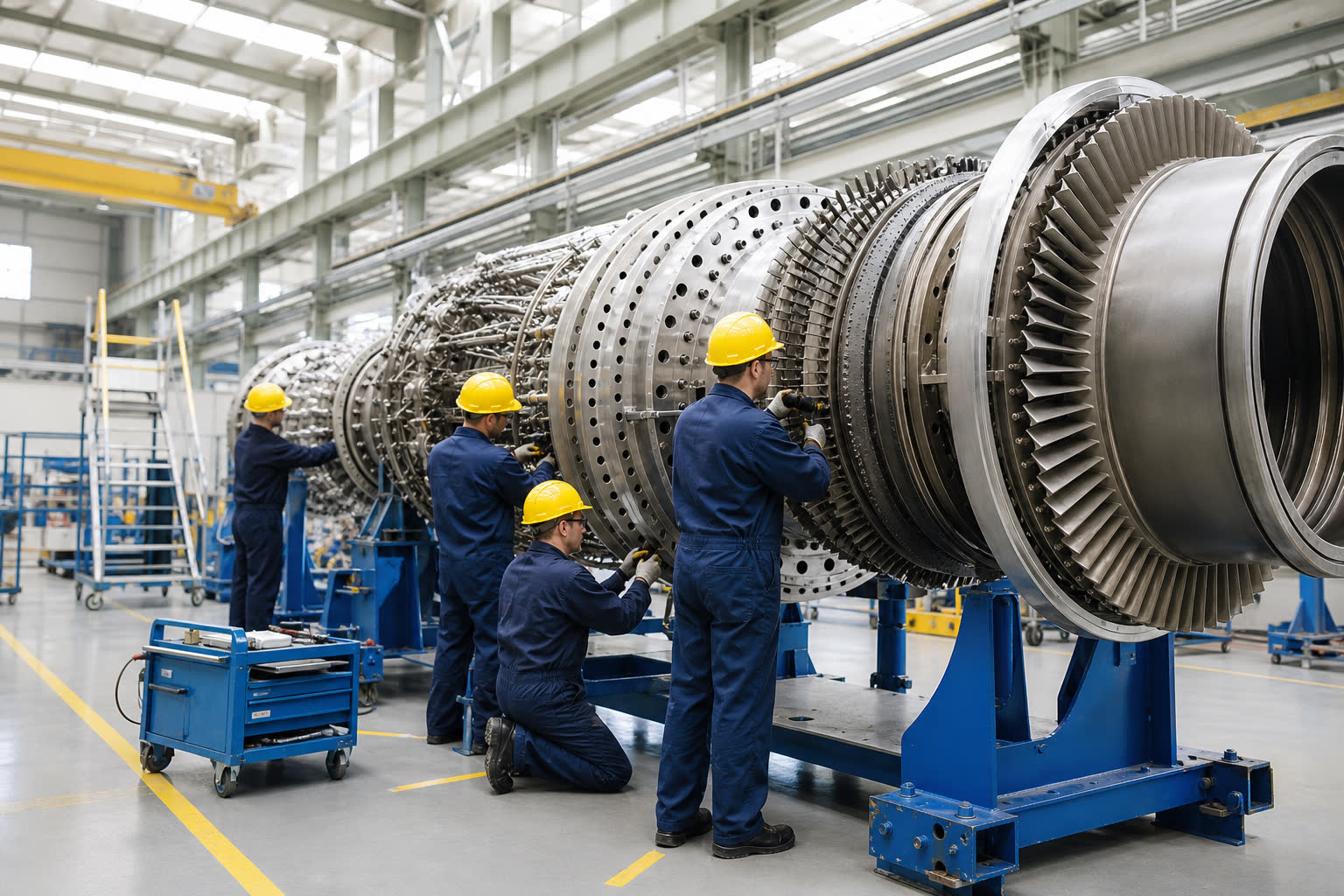
The 2022 shock was a pipe under the Baltic that made a number on a utility bill small enough to size whole product lines around.
A product line that only made sense at the old gas price will not be saved by a speech about virtue.
BASF's Ludwigshafen is not a mood. It is an address where crackers and downstream chains were coherent when gas was cheap and Russian. A complex that made sense at one power price can be fatal at another without being badly run. Ludwigshafen is the exposed hall on that sentence.
Siemens built halls the same way. Turbines, drives, grid equipment: businesses whose margins assumed a European industrial customer paying a predictable watt. When the watt moves, the customer mix moves first. Some product lines stay because they export into markets that never had the pipe. Some lines shrink because the home market was the pipe.
It delivered a price that let German chemicals and heavy industry treat gas as a given input, the way American tech treats cloud compute as a given input until the invoice changes. Politicians turned the route into a weapon. Operators turned it off. The bill did not ask whether Ludwigshafen agreed with the policy.
That is why this page refuses the phrase German industry as one character. The pipe changed a input cost. Input costs sort winners by address and by molecule, not by patriotism.
Covestro and Evonik share the bill
Covestro and Evonik are not footnotes. They are the same changed bill seen from polyurethane and specialty chemicals. A strategist can show a slide about reshoring or China risk. A utility in the Ruhr that cannot deliver a predictable watt removes a product line faster than the slide arrives.
The model was a pipe under the sea. The model now is hall-by-hall survival: which cracker runs, which line idles, which export market pays enough to cover a European power price that no longer has Russian gas in the denominator.
What closes and what learns
Some halls will learn the new price because their mix already lives on exports, on specialty margins, or on assets that can throttle. Some halls will close because they were the margin tail at the old number and nobody needs the volume enough to subsidize the watt. It is arithmetic.
Name the address, the product line, and whether the home market still exists at the new input.
Siemens and BASF were built as a system around a route. The route is gone. The system has to be re-priced without pretending the old number is coming back because speeches were given.
The Ruhr veto
It is another map of the same question: can this grid region deliver power at a price that keeps the hall open? A utility that serves steel, chemicals, and machine tools cannot be treated as a backdrop. When the watt is unstable, the customer is unstable, and the equity story is secondary to the invoice.
Regional politics matter because siting matters. A tariff can assign curtailment. It cannot recreate a cheap molecule that no longer arrives by pipe. It is which halls are still economic when the molecule is priced like the rest of Europe.
Talk about Ludwigshafen or the Ruhr, not about German industry as a mood.
Praise the Mittelstand after you know which hall in Ludwigshafen or the Ruhr can pay the new power price.