IONQ
10-Q filed 10 August
IonQ
80.05 million · RPO 485 million
The owned scan of 5 September printed IONQ at 39.52, up 0.8 percent on five days. The catalyst line still said Quantum. The 10-Q is the object.
Thesis Maps · Opened 22 Aug
Rigetti printed 5.14 million dollars. D-Wave printed 3.08 million. A qubit roadmap does not classify those invoices.
Thesis map
A qubit count is not a purchase order. IonQ booked 80.05 million of Q2 revenue and 485 million of remaining performance obligations on the 10-Q filed 10 August.
IonQ Q2 2026 revenue was 80.05 million dollars on the 10-Q filed 10 August, with 485 million of remaining performance obligations and a 280 to 290 million dollar guide. Five days earlier the investor-relations page said approximately 60 percent of the quarter was commercial. Rigetti printed 5.14 million dollars. D-Wave printed 3.08 million. A qubit roadmap does not classify that invoice.
The chain
Qubit count
A qubit number is not revenue, not remaining performance obligations, and not a guide. Roadmaps publish. Invoices classify.
Purchase order
IonQ booked 80.05 million of Q2 revenue. Approximately 60 percent of the quarter was commercial on the 5 August investor-relations page, defined as non-US-government customers and leading universities.
RPO
Remaining performance obligations 485 million. Guide 280 to 290 million. Those two objects grade the book. A qubit count does not.
Commercial mix
The published rule counts universities as academic, not as a paying enterprise workload. Named does not mean the mix is clean.
Long side
Owns the scarce object. Named filing, named plant, named queue.
IONQ
10-Q filed 10 August
IonQ
80.05 million · RPO 485 million
The owned scan of 5 September printed IONQ at 39.52, up 0.8 percent on five days. The catalyst line still said Quantum. The 10-Q is the object.
IBM
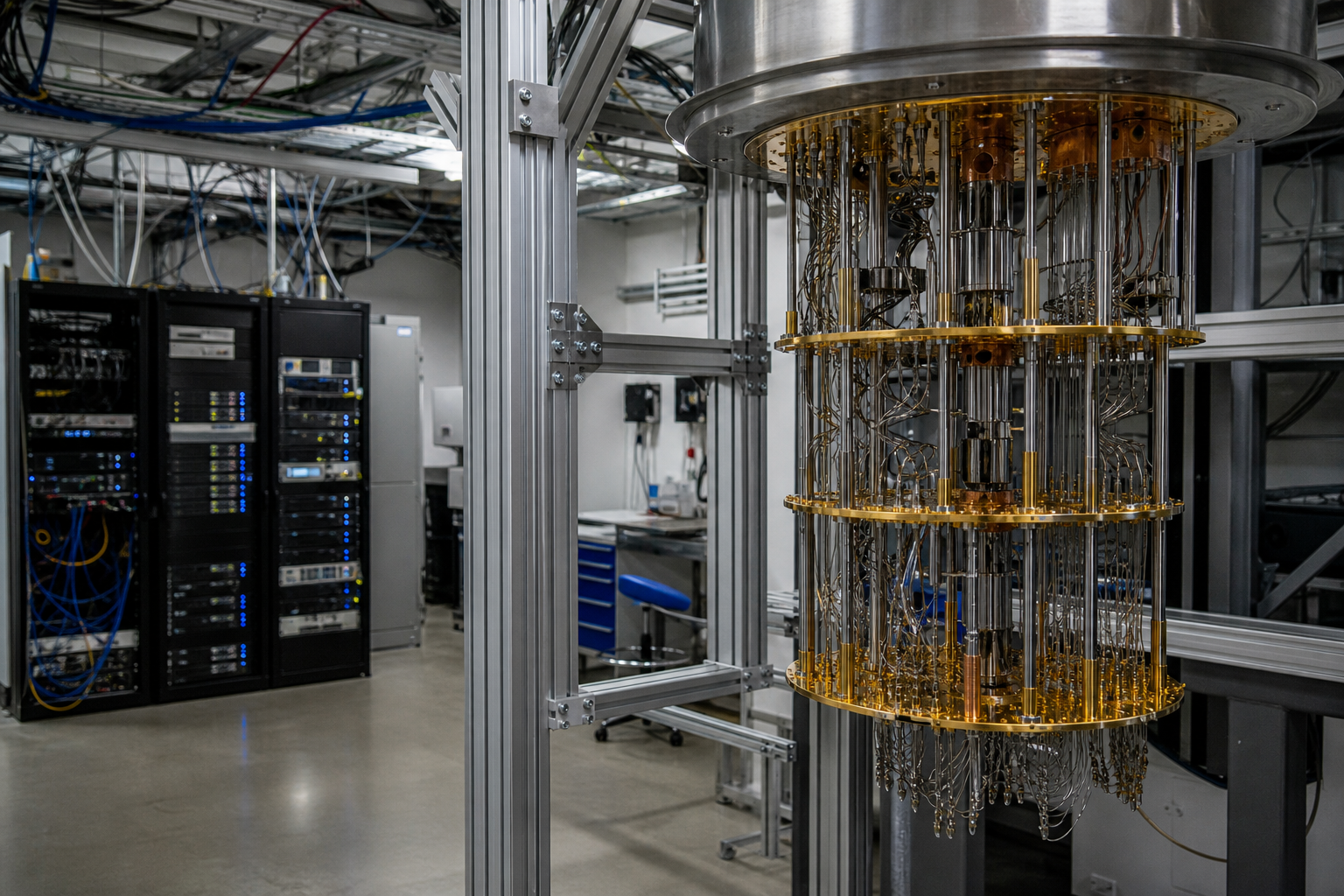
IBM chandelier
IBM sits on the theme page as the incumbent chandelier photograph, not as a Q2 mix comparator. The photograph is not IonQ remaining performance obligations.
RGTI
Rigetti
5.14 million
Rigetti printed 5.14 million dollars. That is an invoice scale, not a qubit roadmap. It is not 80.05 million.
QBTS
D-Wave
3.08 million
D-Wave printed 3.08 million. SkyWater closed on 31 July for 1.8 billion dollars. Neither number is a qubit count.
Short side
Constrained by the chain, or a substitute that is not the product.
short
Roadmap qubits
A roadmap qubit is not an invoice. Publishing a count does not roll into remaining performance obligations.
short
Grant revenue
A grant is not computation revenue. The invalidation on this theme excludes grants from the 100 million trailing-twelve-month test.
short
Scan print 39.52
39.52 on 5 September
A 5 September print of 39.52 is a name on a scan. Seven Form 4 buys do not classify the 10-Q.
How they interconnect
Qubit countis notPurchase order
A qubit count is not a purchase order. IonQ 80.05 million on the 10-Q filed 10 August is the order that printed.
Purchase orderrolls intoRPO
A purchase order rolls into remaining performance obligations. 485 million is that book.
Purchase orderstill needsCommercial mix
Commercial mix still has to survive the published rule. Universities are academic, not enterprise, on that page.
IonQprintsPurchase order
IonQ prints the invoice. The guide is 280 to 290 million. The scan is 39.52.
IBM chandelierphotographsQubit count
IBM photographs the chandelier. That incumbent image is not IonQ remaining performance obligations.
Rigettiprints a smallerPurchase order
Rigetti 5.14 million is an invoice. It is not 80.05 million. Scale is the grade.
D-Waveprints a smallerPurchase order
D-Wave 3.08 million is an invoice. SkyWater at 1.8 billion on 31 July is a foundry close, not a qubit.
Roadmap qubitspublishesQubit count
Roadmap qubits publish. They do not invoice. A count is not remaining performance obligations.
IonQis notGrant revenue
IonQ commercial mix is the test. Grant revenue does not satisfy the 100 million computation clock.
IonQis notScan print 39.52
The 10-Q is not the 5 September scan. 39.52 does not unprint 80.05 million or 485 million of remaining performance obligations.
If you believe the thesis
The invoice and remaining performance obligations grade the name. A qubit count does not. Universities count as academic under the published rule, not as a paying enterprise workload. IBM sits on the theme page as the incumbent chandelier photograph, not as a Q2 mix comparator.
If the thesis is incorrect
A listed pure-play reports more than 100 million of trailing-twelve-month computation revenue, excluding grants, before 2028. Then the qubit count was a product. A 5 September print of 39.52 is a name on a scan. Seven Form 4 buys do not classify the invoice either.
It is a dilution refrigerator: stacked plates, a forest of coaxial lines, a temperature a fraction of a degree above absolute zero. That is the machine IonQ, IBM, Rigetti, and D-Wave are selling from. The photograph on this page is the shop floor.
IonQ printed $80.1 million in the second quarter, up 287 percent. The company guided $280 to $290 million for the year and showed $485 million of remaining performance obligations. Equity value around $16.5 billion. Shares outstanding 368 million. Inder Singh, the chief financial officer, said about 60 percent of the quarter was commercial, and he put leading universities inside that word. Allied ministries and national labs sit there too. That is how a platform is born. DARPA paid for the first GPS birds. Universities ran the first internet nodes. The first quantum letters look the same.
SkyWater is a $1.8 billion close. About $120 million of intercompany vanishes on consolidation. Singh also said 50 percent of revenue was international and 25 percent was multi-product. Government will grow some quarters. That is a customer with a budget, not a hole in the story.
The same week IonQ, Rigetti, and D-Wave moved with the Nasdaq: Friday +8.0 percent, +11.5 percent, +8.5 percent, after a Friday-to-Friday of -3.0, -4.8, and -3.7. D-Wave printed about $3.08 million in the quarter. Rigetti about $5.14 million. Those two are earlier. IonQ is the one with a letter large enough to read. One filing is not the sector. It is the first company in the sector that already looks like a business.
Fifty-eight times trailing sales is a software price on hardware that still has a science department. That is the exciting part. The market is paying now for compute that does not exist on a classical rack: chemistry that will not fit in a simulation, optimisation that eats a data centre, sensing and timing that a ministry will not buy from a foreign fab. Honeywell already lives in that adjacent hardware. Microsoft and IBM are the incumbents who have to name a paying external customer or the new names keep the option.
The honest risk is dilution. Shares outstanding up 46 percent year on year. An acquisition that issues more than 10 percent of the company to buy time is capital filling in for a late customer. Write that when it happens. Do not write it as if the chandelier were a school experiment.
Friday's 8 percent was the Nasdaq and the names. Write the foundry, the $80.1 million, and the $485 million book until a bigger letter arrives.