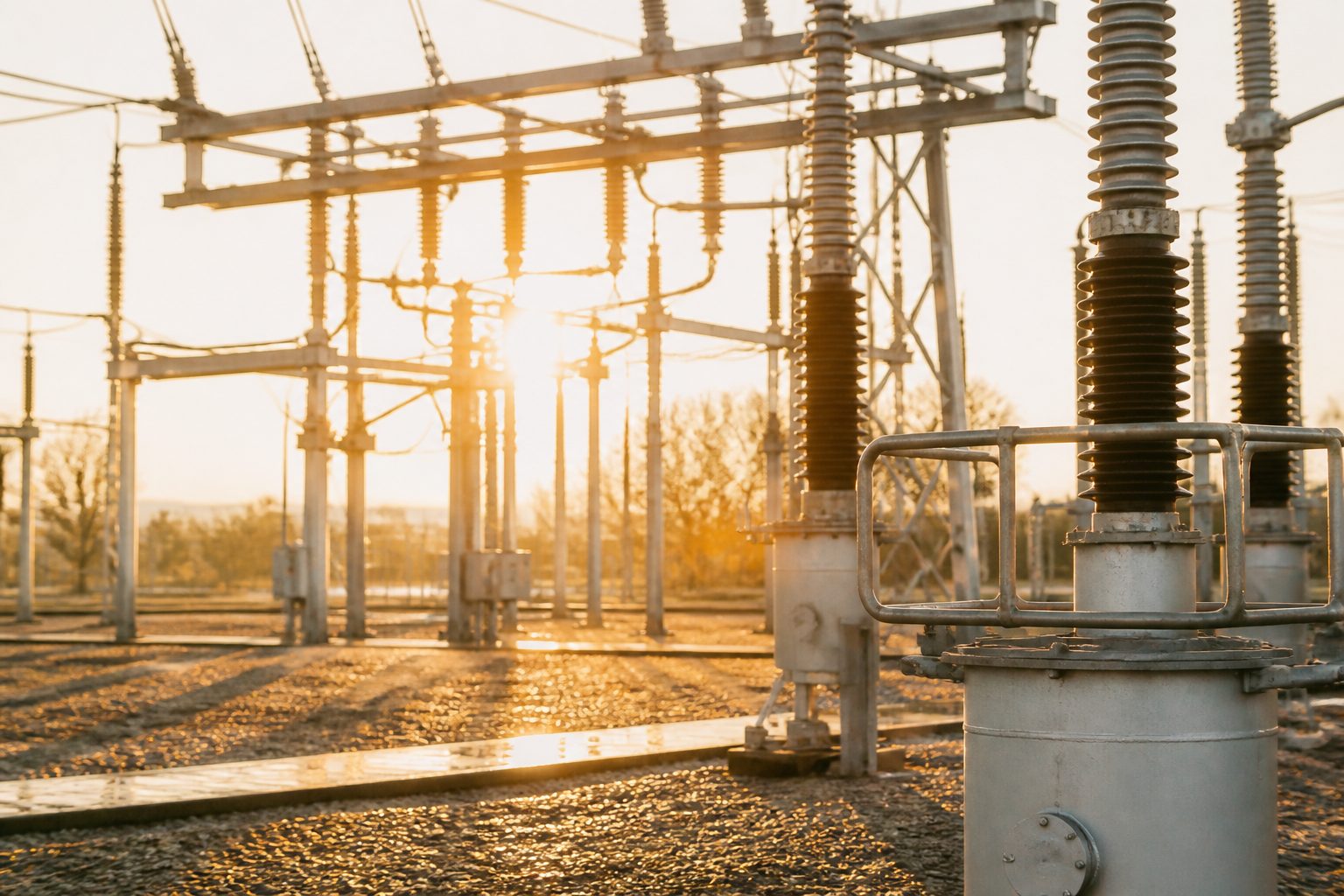
A Large Load that does not bring new steel is first to go dark. That is what PJM filed on 13 August: Interim Resource Adequacy Service, docket ER26-3380, order asked by 12 October. New large loads that skip dedicated new capacity will still be allowed to connect. They will also eat the shortage. The grid did not say no to AI. It said prove your own power.
Chip delivery still matters. A turbine slot booked into 2031 matters more.
A Large Load, in PJM’s definition, is 50 megawatts or more of peak demand at a single site, or affiliated load within a one-mile radius. That radius exists so nobody splits a 200 MW campus into four 49 MW interconnects and calls it residential. Incremental load after 1 June 2027 that pushes an existing site over 50 MW is treated as new. Interim service without “bring-your-own-new-capacity” (BYONC), and without cover from the Reliability Backstop Procurement, means curtailment ahead of pre-emergency demand response, the resources that are already paid to drop. Residential load stays behind that line. The AI hall does not.
FERC’s combined notice put comments at 3 September, 5 p.m. Eastern. The order they asked for is 12 October. The evidence calendar sits in March–April 2027. Three clocks, none of them the June service date the campus team is staring at. Data Center Knowledge had the comment date; the docket is still ER26-3380.
PJM’s July note says the megawatts have to be new, and the resource has to sit in the capacity auction as a price-taker for ten delivery years. A delayed retirement does not count. An RMR plant does not count. You cannot rent last year’s hall and call it proof.
Conditional access, not a veto
Two other pieces of the filing matter as much as the curtailment stack. PJM will keep a Large Load Registry, location, megawatts, and whether the site brought supply, and share it with states, subject to confidentiality. And beginning with the 2029/30 capacity auction, uncovered incremental large-load demand comes out of the demand curve. PJM wrote the reason in plain language: “the rest of PJM’s load should not be exposed to the price impacts” of new large loads procuring through the regular auctions instead of bringing supply.
That is a bargaining position. Chip delivery dates still matter. Rack density moving from single-digit kilowatts to tens or hundreds is still a building-electrical problem. Neither is the binding constraint for a 200 MW training hall that wants a 2028 service date in northern Virginia. The binding constraints are a turbine slot, a transformer, and a rule that says: if you did not bring the electrons, you are first in the dark.
A modern AI hall that would have been a 20–30 MW object in 2024 is a 50–100 MW object now, and a campus is several halls. The one-mile cluster rule is how they keep the class from becoming a paperwork exercise.
The chips arrive on the buyer’s clock. The electrons arrive on the supplier’s. PJM just wrote that into the tariff.
The queue behind the tariff is already a different number
Dominion Energy Virginia serves the largest data-centre market in the world. The 2025 coincident peak in that industry inside Dominion was about 4 GW, larger, the company told PJM, than the next five US markets combined. Seven of 54 customers were 72% of year-to-date demand. The contracted stack as of July 2025 was 47 GW: 9.8 GW already connected under electric service agreements, 7.1 GW under construction letters, 30.1 GW under engineering letters. Dominion’s own demand forecast for 2046 is 16.6 GW, not 47. That gap is the whole argument. PJM’s load-forecast process has been trying to discount that stack, utilization assumptions around 70% unless a site can prove otherwise, a “firm” versus “non-firm” split, a refusal to take the engineering-letter pile at face value.
By February 2026 Dominion’s large-load delivery-point queue had grown to 70 GW. About 25 GW had projected connection dates through 2031. Forty-five GW sat under study with no date. The State Corporation Commission had already forced a formal queue: delivery-point requests of about 100 MW or more, a 300 MW cap on a single request, first-come first-served in batches of roughly ten, 2–3 GW a batch. Time to energization is measured in years. PJM, looking across the RTO, has been willing to write “up to ~30 GW” of data-centre growth between 2025 and 2030 into the load-forecast conversation, and to note that it is already about 40% of US data-centre load. Capacity prices in the region have printed above $300 per MW-day. That is the retail-politics fuel for IRAS. Households in Virginia and Pennsylvania do not want to pay a capacity price that was set by a training cluster in Loudoun.
An earlier cut left this stack as “data pending” and refused to substitute an equity print for a queue report. That instinct was right. The public reports are now thick enough to stop hiding behind it. Dominion’s 47-versus-16.6 and 70-versus-25 are the two ratios that matter. The first is how much of the press-release pipeline the utility itself does not believe. The second is how much of the queue has a date. IRAS is what you write when the second number is the one that will show up, and you do not want the first number in the demand curve.
The physical queue is booked into the next decade
GE Vernova’s gas-turbine book is the cleanest public proxy for “prove your own power.” Directional lead times on new heavy-duty units are about three years. The combined backlog of orders and reservations has been printed in the 100–116 GW range this year; CEO Scott Strazik is taking 2031 reservations and has said the company is on track to be more than halfway contracted for 2031 by year-end. About 20% of the gas-power book is explicitly data-centre / AI load. The other 80% is utilities, IPPs, and industrials in two dozen countries. A data-centre CFO cannot simply outbid the queue. The queue is already a multi-country industrial queue. Strazik has also said the turbine is often not the gating item once you count EPC, permitting, and fuel. It is a longer critical path.
Transformers are worse. Lead times that were 24–30 months before 2020 are being quoted around five years. GE Vernova’s Prolec close added a $5 billion transformer book to a market that cannot clear. Hitachi’s South Boston, Virginia plant and Siemens Energy’s Charlotte plant, both due 2027–28, do not relieve a 2026 order. A campus that has GPUs in the 2027 plan and no transformer PO from 2025 has a slide, not a delay. Industry notes that only about a third of the 12–16 GW of data-centre capacity planned for 2026 is actually under construction; the rest is waiting on kit.
XLU falling 3.48% in the week of 17–21 August, and 2.28% on Friday, does not shorten any of this. Henry Hub, turbine slot prices, and the next official large-load publication are the relevant tape. Treating XLU as a refutation of the bottleneck is the same error as treating Friday’s VIX fade as a weekly vol story.
Texas already voted with steel
Microsoft and Chevron signed a 20-year PPA for Project Kilby in West Texas: about 2.67 GW of dedicated gas, mostly GE Vernova machines plus Solar Turbines (Caterpillar), first power targeted 2028, FID expected by the end of 2026, mid-teen returns on Chevron’s telling. The plant is designed to run independently of ERCOT at first. Amazon has disclosed GW Ranch, also in Pecos County, its first private behind-the-meter campus, with permits describing up to 35 turbines and 7.65 GW, plus 750 MW of solar and 1.8 GW of batteries, initially off the Texas grid. Amazon’s public sentence is the tell: the campus is “powered by new on-site generation that won’t raise electricity costs for Texas families and designed to transition to grid-connected service as interconnection timelines allow.” That is a power company describing a future rate case. Industry trackers count something like 60 behind-the-meter gas projects since the start of 2025, totaling around 90 GW. Most will slip. The ones with turbines and a named offtaker will not.
xAI’s Colossus in Tennessee already has GE Vernova turbines on the ground. OpenAI’s Stargate in Texas has nearly a gigawatt more in the Cleanview tally. Meta has been in the papers on an El Paso-area project with BlackRock taking the majority of the generation. The hyperscaler-as-power-company hypothesis is no longer a 2027 story in ERCOT. PJM’s filing is how the same story arrives in the Mid-Atlantic, where you cannot disappear into the Permian and call it behind-the-meter as easily, and where the ratepayer is organized.
Energy X and data-centre X still talk past each other. One posts renderings of 1 GW campuses and “demand is insatiable.” The other posts interconnection PDFs and “half of this will never get built.” Both are directionally right and operationally useless. The question the filing answers is: of the load that does get built, who eats the shortage? IRAS’s answer is the load that did not bring steel. The Texas answer is: bring the steel yourself, then argue about connecting it later. Those are the same bargain in two ISOs.
What $300 per MW-day is doing to the politics
PJM’s capacity market is a three-year-forward auction for the right to be paid to be available in a delivery year. When that price prints above $300 per MW-day, a household in a constrained zone is being asked to fund a reserve margin that was set by a load the household did not invite. That is why IRAS exists, and why the 2029/30 demand-curve exclusion exists. It is a rate case written as a tariff.
BYONC is the valve. The short version compressed this into “prove your own power.” The filing is more precise: prove it with new steel, on a calendar, or accept a lower quality of service and stay out of everyone else’s capacity price. Conditional access is the product.
ERCOT’s version of the same bargain is geographic. West Texas has gas, land, and a grid you can temporarily refuse to join. That is why Microsoft and Amazon did Kilby and GW Ranch in Texas first, and why the Mid-Atlantic will not get an identical copy. Behind-the-meter in northern Virginia is a fight with Dominion, the SCC, and a 70 GW delivery-point queue. Behind-the-meter in Pecos is a fight with turbines and transformers.
The calendar people actually miss
Project teams stare at June 2027 service dates. The evidence calendar is earlier. BYONC designations, registry entries, and the first assignment of IRAS responsibility have to exist before the 2027/28 delivery year starts. March–April 2027 is when the paperwork has to be real. A campus that is “in the queue” but cannot point to a turbine slot, a transformer, or a backstop allocation is rehearsing a curtailment, not a ribbon-cutting. FERC’s October 12 clock is the step before that. An order that waters down curtailment priority, or that lets states keep the old socialized capacity treatment, is a different market than the one PJM filed.
The dated twin of the structural claim is simple. The next published PJM and ERCOT large-load figures both have to print above the prior publication. If they do not, the bottleneck is already rationing demand, and the equity story in power equipment has to live on price and mix, not on an ever-rising megawatt line. NVIDIA’s Wednesday-night commentary is an input to that count, how often “constrained,” “self-generation,” and “interconnection” show up, not a substitute for the ISO publications.
Community opposition and labour are the unpriced residual. Jefferies has been writing it as a dampener on announced load. A tariff can assign curtailment. It cannot site a turbine in a county that does not want one, and it cannot staff a five-year transformer plant that does not yet exist. The prove-your-power calendar has three clocks: the FERC order, the steel, and the neighbours. Only the first one has a docket number.