Comments on PJM Interim Resource Adequacy Service, docket ER26-3380, closed 3 September. The order they asked for is 12 October. Utilities still printed green while the 10-year rose two basis points to 4.78 on Friday 4 September. Energy was up 1.66 percent. Technology was down 1.51 percent. That is not a rates gift. Owners left the week of 17 to 21 August, when Utilities fell 2.28 percent on the Friday as the 10-year rose four basis points to 4.74.
The queue series that is wired is ERCOT: 474 GW of large-load interconnection requests as of June 2026, from the Senate testimony on 29 July, up from 438 GW in the 24 May update. That is a request pile, not energised load. PJM still has no ERCOT-style request queue. Its 2026 long-term load forecast speaks in increments. We will not relabel a forecast increment as a queue. Dominion’s own numbers are the ones that belong on this page: about 4 GW of data-centre load in the 2025 peak, 47 GW contracted against a 16.6 GW 2046 forecast, and a delivery-point queue around 70 GW with 25 GW dated through 2031. The first ratio is how much of the press-release pipeline the utility itself does not believe. The second is how much of the queue has a date.
Prove it with new steel
On 13 August PJM filed Interim Resource Adequacy Service with FERC, docket ER26-3380, and asked for an order by 12 October. A Large Load is 50 MW or more of peak demand at a single site, or affiliated load within one mile. Interim service without newly built dedicated supply means you are first to curtail when the grid is tight. Bring Your Own New Capacity is the valve: designate qualifying new generation for the required duration, or accept a lower quality of service and stay out of everyone else’s capacity price. The 2029/30 demand-curve exclusion is the political twin. When capacity prints above $300 per MW-day, a household in a constrained zone is being asked to fund a reserve margin set by a load the household did not invite. IRAS is a rate case written as a tariff.
Project teams stare at June 2027 service dates. The evidence calendar is earlier. BYONC designations, registry entries, and the first assignment of IRAS responsibility have to exist before the 2027/28 delivery year starts. March–April 2027 is when the paperwork has to be real. FERC’s 12 October clock is the step before that. An order that waters down curtailment priority, or that lets states keep the old socialized capacity treatment, is a different market than the one PJM filed.
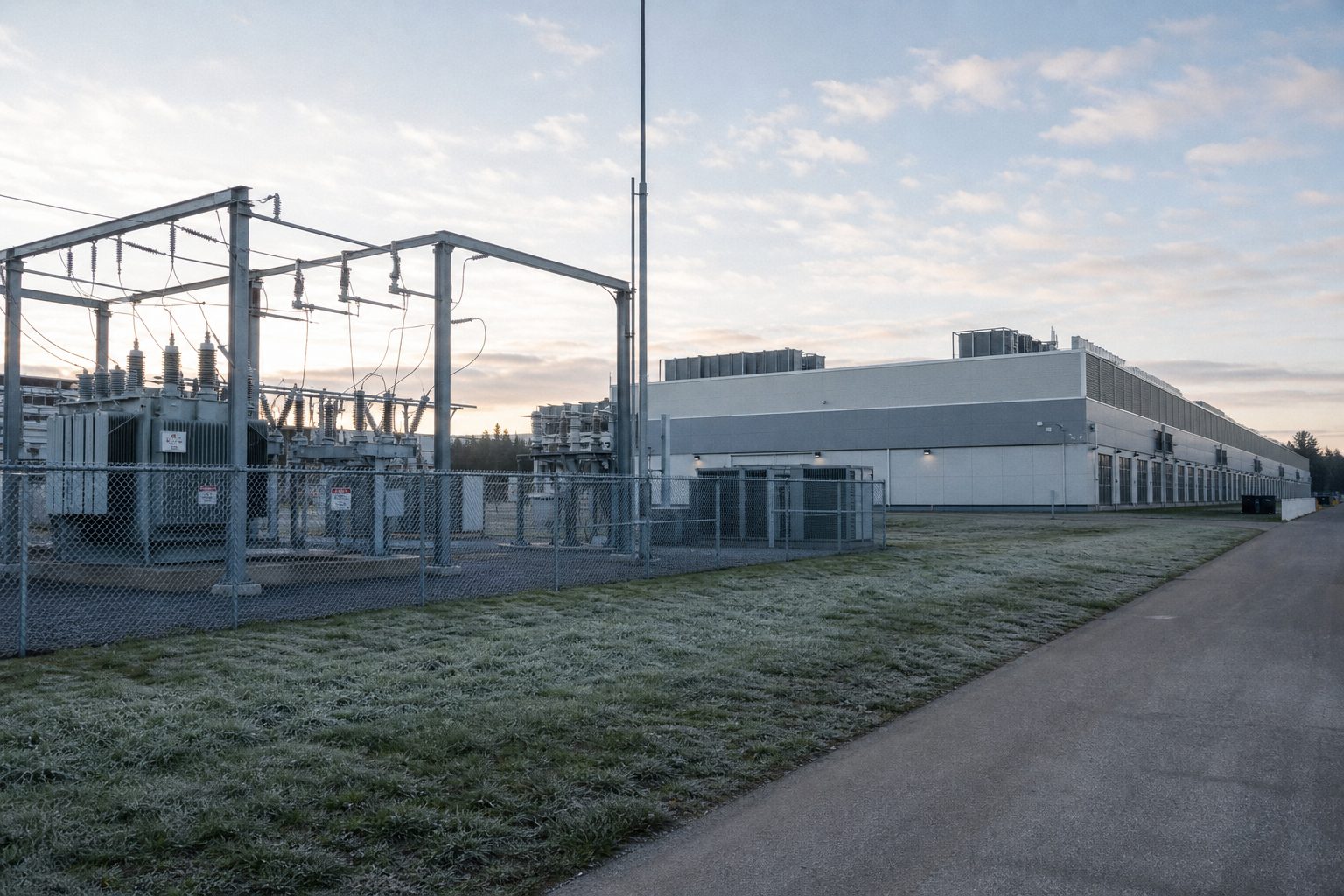
GE Vernova-class turbine slots run into 2031. The company has said data centres are about 20% of the book. Transformer lead times are measured in years, often five. You can buy a GPU this quarter. You cannot buy a turbine. Microsoft and Chevron’s Kilby site is 2.67 GW for 2028. Amazon’s GW Ranch in Texas is up to 7.65 GW behind the meter. Those bargains happened in Pecos County, not Loudoun County. Behind-the-meter in northern Virginia is a fight with Dominion, the SCC, and a 70 GW queue. Behind-the-meter in West Texas is a fight with turbines and transformers. Both end at the same sentence: the campus that cannot point to generation is not a 2027 service date.
The claim is the structural claim: before the end of 2027, at least one major hyperscaler announces wholly-owned electricity generation for AI load, built and operated, not a PPA. Purchase agreements, however large, do not count. Ownership does.
What the equities are allowed to say
The claim grades one comparison on 30 November: 60-session correlation of XLU with XLK versus correlation of XLU with the inverse of the ten-year yield change. Live through 21 August that is about −0.25 versus +0.17. Utilities are closer to a rates trade than to Tech on that rule, today. The hypothesis can still win if the ownership returns. It has not returned this month.
The path, not the vibe, is on the utilities insight. 60-session XLU–XLK printed +0.61 in April 2025 and +0.60 in June 2025, the AI-power ownership trade, and is −0.25 now. The 250-session window has come from +0.39 at end-2025 to −0.03. A year of “utilities are tech” is a rounding error on the long window. None of that is a queue update. A correlation path is what the owners did with the stocks.
the next published PJM and ERCOT large-load figures both print above the prior publication. The ERCOT leg grades against 474 GW. The PJM leg waits on a comparable print. Either down is the first of two updates toward a queue already rationing demand, and the equity story in power equipment having to live on price and mix. on the Q3 2026 calls, all four of the largest hyperscalers reference power, electricity, or grid capacity as a constraint on deployment. Two or fewer of four, and the constraint has stopped being worth mentioning. NVIDIA on Wednesday night is an input to that count, “constrained,” “self-generation,” “behind-the-meter,” “interconnection”, not a one-night grade.
Community opposition and labour are the unpriced residual. A tariff can assign curtailment. It cannot site a turbine in a county that does not want one, and it cannot staff a five-year transformer plant that does not yet exist. The prove-your-power calendar has three clocks: the FERC order, the steel, and the neighbours. Only the first one has a docket number.
Henry Hub is a live tile from NYMEX NG=F. Natural gas is a structural demand floor if the campuses get built on gas. Uranium and enrichment stay pending rather than spammed. The chips arrive on the buyer’s clock. The electrons arrive on the supplier’s. This week’s XLU print did not change either clock.
Rate base is not the same trade as the turbine
If the queue is the moat, incumbent colocation with an existing interconnect and utilities with load growth in-territory get pricing power on power. That is a rate-case story. If turbines are the bottleneck, GE Vernova, Siemens Energy, and Mitsubishi get backlog and price, and the equity that owns them is not XLU. If hyperscalers become generators, capex mix shifts from servers to plant and the independent power producer, the gas developer, and the nuclear restart file get the bid. Those three if-thens can print in the same year and pull XLU, GEV, and a hyperscaler in three directions. Averaging them into “AI power” is how 2025’s +0.60 correlation got written. It is also how 2026’s −0.25 got earned.
Regulators decide who pays for the interconnect. State utility-commission dockets are not a series. They are a risk to the “utilities win” leg. A world where large-load tariffs shove the cost onto the campus is a world where the regulated equity’s upside is smaller than the 2025 ownership assumed. IRAS is that shove, written as a federal tariff. The 12 October order is whether FERC lets it stand.
Efficiency revises the megawatt plan
A hyperscaler that revises megawatt plans down because compute-per-watt improved will arrive as a sentence in a 10-K. Until that sentence appears, an AI demand headline that ignores prove-your-power calendars is a GPU press release.
NVIDIA’s Wednesday commentary is a count, not a grade. How often “constrained,” “self-generation,” and “interconnection” show up feeds. One upbeat GPU print with a shrug about turbines is not a refutation of PJM. One cautious GPU print with a paragraph about on-site generation is confirmation that Kilby and GW Ranch are now the customer’s language, not just the ISO’s.
Nothing structural changed this week. The stocks moved. Write it that way.