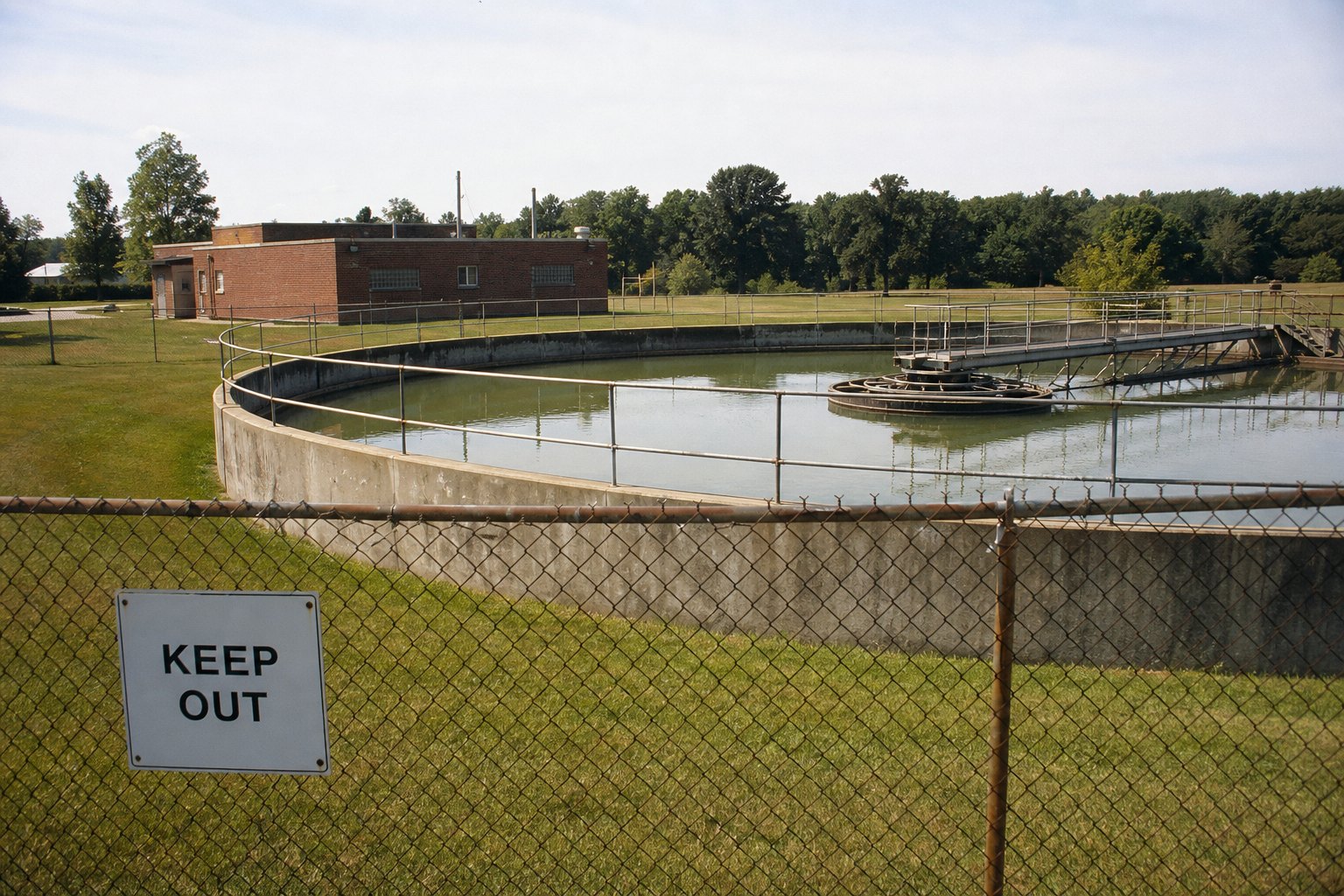
The watt is the public argument. The tap is the private one.
You can wait in a line. You cannot wait a well back into existence.
For two years the AI buildout has been told as a power story. Interconnect queues. Behind-the-meter gas. Transformers with a three-year lead. That story is real, and it is already on the tape. What the tape has not priced is the other permit. A campus that has a letter from the utility and no letter from the water authority is not a delayed interconnect. It is a different building.
Newton County, Georgia, made the distinction public. The county water authority rejected a request on the order of six million gallons a day. The sentence that travelled was simple: we just do not have the water. That is, Hyperscale News, Data Center Knowledge,. Meta’s wells in the same county had already been a New York Times story in July 2025. The wells were the rehearsal. The rejection is the close.
Van Wert, Ohio, is the other close. On 29 May 2026 the city and QTS announced a campus puts the figure near ten billion dollars, with the cooling specified as closed-loop, and with the city’s development office saying water had been the condition. Same year. Same class of building. Different water. The Ohio campus did not invent a river. It stopped asking the river for a once-through answer.
A line and a stock
If the watt is the binding constraint, the names you already know are the trade. If the tap is the binding constraint, those names are a confounder. A rejected water application does not move the interconnect queue. It does not shorten a transformer lead. It just means the building cannot drink. Share prices that treat every delayed campus as a delayed watt are mixing two permits. The hidden book is the cooling vendor who can run a hall on a river that is already spoken for. The wastewater plant that can sell reclaimed gallons. The Great Lakes site that still has a surplus the public meeting has not priced. Those are not glamorous tickers. They are the ones that decide whether the watt ever gets used.
What people are ignoring is the difference between a line and a stock. The interconnect queue is a line. You can wait in a line. The aquifer is a stock. You cannot wait a well back into existence. A closed-loop plant converts a stock problem back into a line problem, capital, time, a different radiator. That is why Van Wert matters more than another press release about megawatts. It is a proof that the second permit can be redesigned. It is also a proof that the first design, the one that asked the county for six million gallons a day, is no longer the default.
The visionary version is that the next decade of compute sits where the water authority will still say yes, or where the cooling loop no longer needs the authority’s surplus. It runs through municipal minutes, well permits, and the quiet vendors who sell a radiator that does not drink. It is a split: campuses that cleared both permits, and campuses that cleared one.
The watt cleared. The tap did not.